


Description
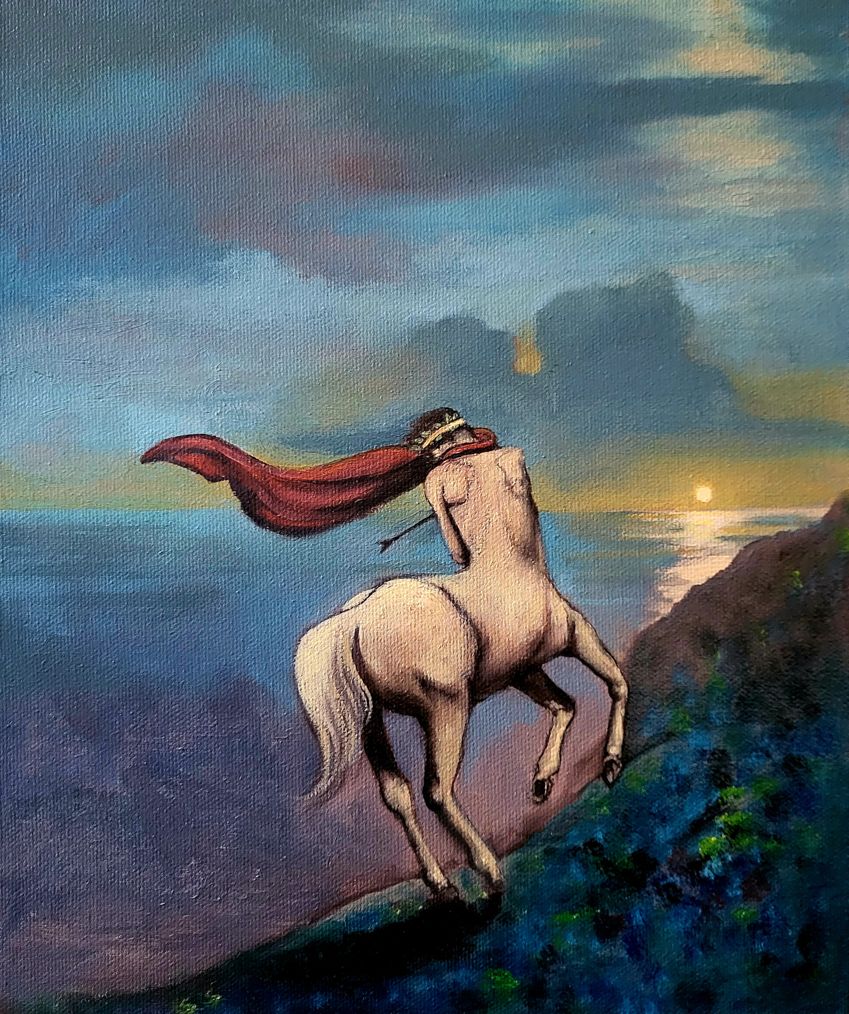
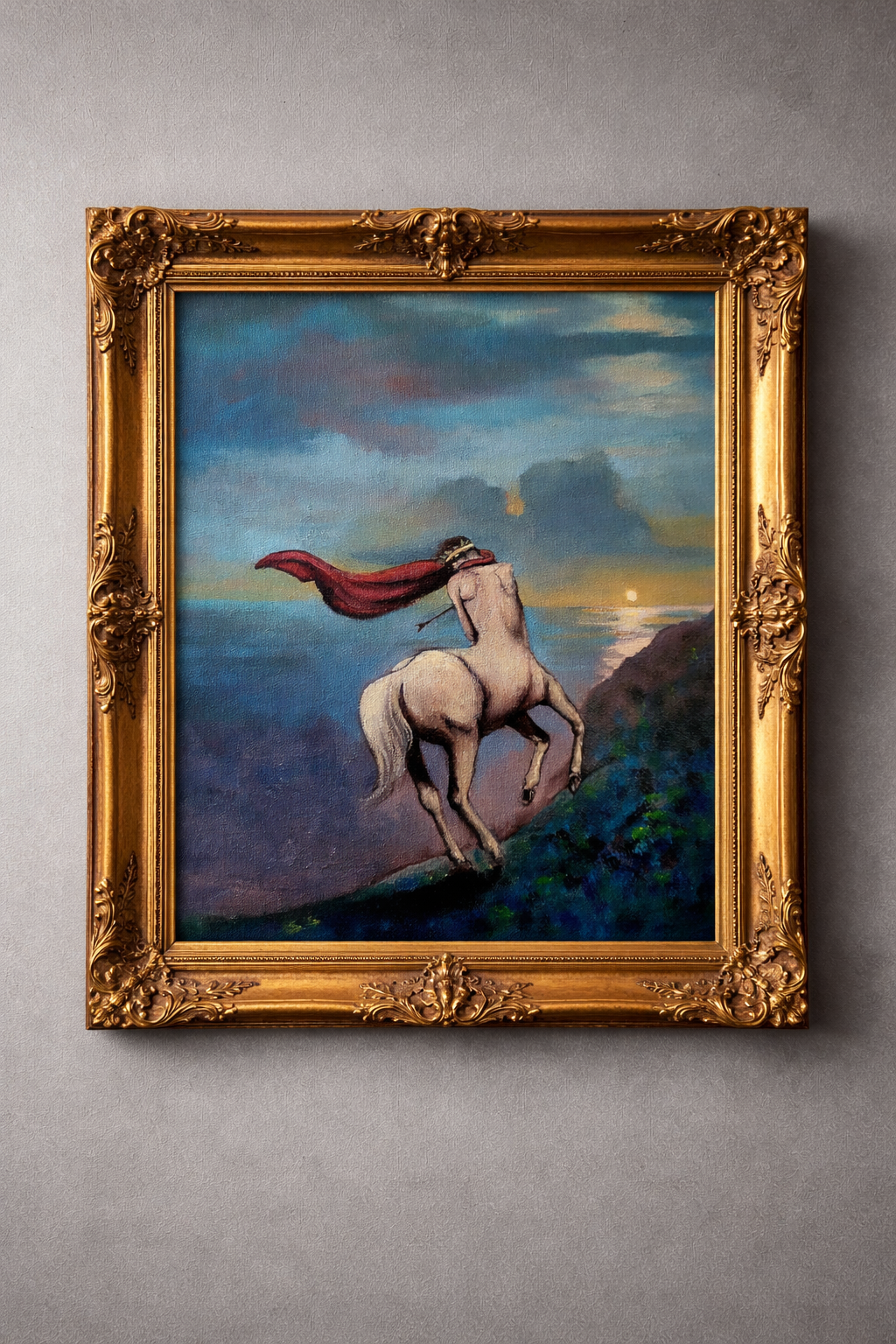
The Death of Chiron
Oil on canvas.
12. 7 x 9.3 inches
Comes with custom frame upon purchase.
The Death of Chiron: Symbolism of the Wounded Healer
In Greek mythology, most immortal beings do not die. They rage, love, punish, and vanish, but they do not cease to exist. Chiron is the profound exception. Unlike his brutish centaur brethren, Chiron was known for wisdom, medicine, music, and mentorship. He tutored heroes such as Achilles, Asclepius, Heracles, and Jason. And yet, this gentle and learned figure met an end that has echoed through psychology, philosophy, and art for millennia. His death was not a violent conquest or a divine punishment, but an accident of mercy, sacrifice, and unbearable pain. The symbolism of Chiron’s death offers one of the most enduring archetypes in Western thought: the wounded healer.
The Myth of Chiron’s Wounding and Death
To understand the symbolism of his death, one must first understand how he was wounded. Heracles, while fighting the centaurs, accidentally shot Chiron in the thigh with an arrow poisoned with the Hydra’s blood. Because Chiron was immortal, the wound would not kill him, but neither would it heal. He was condemned to live forever in excruciating agony, the poison burning endlessly through his divine flesh. This is the first layer of symbolism: the incurable wound. Chiron, the master of medicine and healing, could not heal himself. He possessed all the knowledge in the world for treating others, yet his own suffering remained beyond remedy.
After years of torment, Chiron struck a bargain with Zeus. Prometheus, the Titan who had given fire to humanity, was chained to a rock, his liver devoured daily by an eagle. Chiron offered his own immortality in exchange for Prometheus’s freedom. Zeus accepted, and Chiron was allowed to die. He was placed among the stars as the constellation Centaurus.
The Wounded Healer Archetype
The most famous symbolic interpretation of Chiron’s death comes from the Swiss psychiatrist Carl Jung, who coined the term “wounded healer.” Jung observed that the most effective healers, therapists, and teachers are often those who have suffered deeply themselves. Their own wounds grant them two essential gifts: empathy and humility. A healer who has never known pain may offer technique, but a healer who has known pain offers understanding. Chiron could not cure his own leg, but that very disability allowed him to see the suffering in his students with unusual clarity. He taught Asclepius, the god of medicine, not from a position of untouchable divine perfection, but from a body that knew what it meant to hurt.
In modern psychology, the Chironic wound is often understood as a central, defining pain that shapes a person’s life purpose. It is not a minor inconvenience but a core injury—physical, emotional, or spiritual—that cannot be fully resolved. Instead of healing completely, it becomes the lens through which one helps others. A recovered addict becomes a counselor. A grieving parent founds a support group. A chronically ill physician becomes an advocate for better pain management. In each case, the wound is not erased but transmuted into wisdom.
Sacrifice and the Relinquishment of Immortality
Chiron’s death is also a profound meditation on sacrifice. He was immortal, which in Greek terms meant a life without end but not necessarily a life without suffering. His immortality had become a curse. The poison ensured that his eternity would be nothing but agony. By choosing to die, Chiron did something almost no other immortal in Greek mythology willingly does: he surrendered his divinity for the sake of another.
The object of his sacrifice is equally significant. He did not die for a fellow god or for personal glory. He died for Prometheus, the Titan who suffered for giving humanity fire—that is, for giving humanity knowledge, culture, and civilization. Chiron, the teacher of heroes, gave his eternal life so that the benefactor of humanity could be freed. Symbolically, this suggests that the highest form of healing is not self-preservation but self-expenditure. The true healer, the true teacher, does not hoard their gifts. They give until there is nothing left, even if that means their own end.
Transformation and Constellation
The final act of Chiron’s story is his placement among the stars. He did not simply vanish into Hades like a mortal. He was transformed into the constellation Centaurus, visible forever in the night sky. This symbolizes apotheosis through suffering—the idea that profound pain, when accepted and transcended, can lead to a kind of immortality greater than mere biological endlessness. Chiron traded a miserable, finite eternity for a glorious, infinite legacy.
For artists, writers, and thinkers, this aspect of Chiron’s death speaks to the way personal tragedy can be alchemized into lasting creation. Van Gogh’s mental anguish produced sunflowers and starry nights. Frida Kahlo’s physical pain produced self-portraits of astonishing power. Chiron’s constellation is a reminder that the wound, when looked at directly and worked into meaning, does not have to be merely endured. It can become a light source for others navigating their own darkness.
The Refusal to Look Away
Perhaps the most subtle but important symbolism in Chiron’s death is simply this: he did not pretend the wound did not exist. He did not hide his limp. He did not claim, as so many heroes and gods do, to be untouched by suffering. He lived with the pain openly, taught from it, and eventually traded it for the freedom of another. In an age that often demands performative wellness and toxic positivity, Chiron’s example is quietly radical. He says: You can be broken and still be wise. You can be in pain and still be of use. You can die and still become a constellation.
Conclusion
The death of Chiron is not a tragedy in the ordinary sense. It is a transformation. It symbolizes the wounded healer, the sacrifice of immortality for love, the alchemy of pain into legacy, and the quiet dignity of refusing to look away from one’s own suffering. For anyone who has ever felt that their deepest wound might also be their deepest gift, Chiron remains in the night sky—not as a god untouched by sorrow, but as a teacher who finally, mercifully, was allowed to let go.
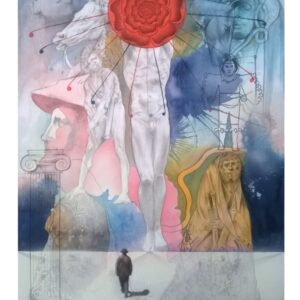
 Christ in the Garden. Original mixed media art work.