

Description
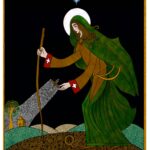
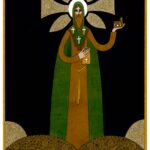
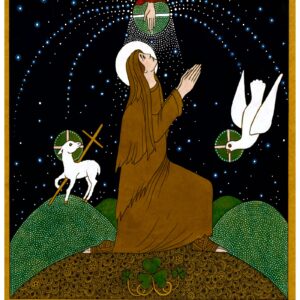
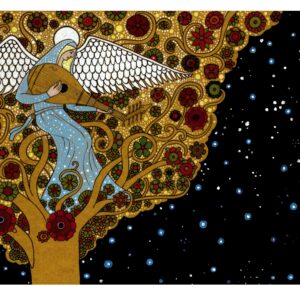
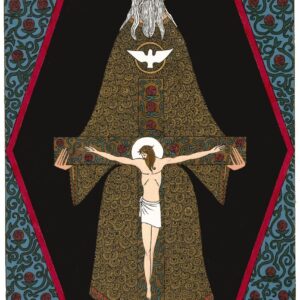
Saint Colmcille.
Fine art print.
A4. 8.3 x 11.7 inches.
All prints are signed by the artist.
Saint Colmcille, also known as Saint Columba, was a prominent Irish missionary and monastic founder who lived in the 6th century. Born in County Donegal, Ireland, Colmcille was known for his zealous devotion to spreading Christianity throughout Ireland and Scotland. He founded several monasteries, most notably the monastery at Iona, which became a center of learning and spirituality and played a crucial role in the spread of Christianity in Scotland.
Colmcille was also known for his strong intellect and scholarly pursuits. He was a skilled scribe and transcriber of manuscripts, and his monastery at Iona became a renowned center of learning, attracting students and scholars from across Europe. Colmcille was also a prolific composer of hymns and poems, many of which survive to this day and provide insight into his spiritual beliefs and devotion to God.
In addition to his scholarly pursuits, Colmcille was also a renowned peacemaker and mediator. He played a key role in resolving conflicts among tribes and kingdoms in Ireland and Scotland, using his influence and charisma to bring about peaceful resolutions. Colmcille’s legacy as a missionary, scholar, and peacemaker continues to inspire Christians around the world to this day, making him one of the most revered saints in Irish and Scottish history.
Saint Colmcille (or Columba) of Iona, one of Ireland’s three great patron saints alongside Patrick and Brigid, stands as a towering figure whose life and legacy are rich with potent symbolism. He embodies the paradox of the warrior-prince transformed into a scholar-monk, and his story maps the journey from passionate, earthly conflict to disciplined, spiritual conquest.
His foundational symbol is the island monastery. His self-imposed exile from his beloved Ireland to found the monastic community on the remote Scottish Isle of Iona represents a profound spiritual geography. Iona becomes a symbolic “desert in the ocean,” a place of austere retreat for penance and contemplation, yet also a radiant center for learning and missionary fervor. It is a liminal threshold, poised between Ireland and Scotland, the familiar and the unknown, acting as a spiritual powerhouse from which Christianity would re-energize northern Britain.
Closely tied to this is the symbolism of exile and navigation. Colmcille’s famous departure, “sailing into exile for Christ,” transforms the coracle—a frail, hide-covered boat—into an emblem of faith-driven destiny. The perilous sea journey symbolizes the soul’s voyage through the trials of life, guided only by prayer and divine providence. His exile, sparked by a bloody conflict over a copied psalter (the Cathach or “Battler”), itself symbolizes the transformation of violent strife into spiritual warfare. The dispute that began with a physical battle over a book culminates in his lifelong battle for souls, turning the scribe’s pen into a mightier instrument than the warrior’s sword.
This leads to his paramount symbol: the book. Colmcille was a master scribe and the founder of a legendary scriptorium. The act of copying sacred texts symbolizes the preservation and propagation of divine wisdom. His dedication to this meticulous, prayerful work positions him as a guardian of light against the perceived “darkness” of paganism and ignorance. Each manuscript produced on Iona was a beacon, literally and figuratively illuminating the Word.
Finally, Colmcille is powerfully associated with nature and creatureliness, embodying the Celtic Christian intimacy with creation. Legends tell of his tender kinship with a tired work-horse and a visiting white dove, and of his curse upon invasive nettles. These stories symbolize the saint’s role as a harmonizer, one who, through his sanctity, restores a rightful, peaceful order between humanity, animals, and the land. He is both a prince of the Church and a compassionate steward of God’s creation.
Thus, Saint Colmcille symbolizes the journey from chaos to order, from battle to peace, and from earthly passion to divine scholarship, all channeled through the disciplined, creative, and missionary fire of monastic life on a sacred isle.
Reviews
There are no reviews yet.