Description
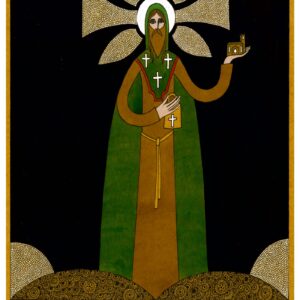
Saint Brigid. Early Irish Saint
Fine art print.
A4. 8.3 x 11.7 inches
All prints are signed by the artist.
Saint Brigid is the Patroness of Ireland, her name means ‘the exalted one’.
Saint Brigid, also known as Brigid of Kildare, is a beloved Irish saint who lived in the 5th and 6th centuries. She is often referred to as the “Mary of the Gael” and is considered one of Ireland’s patron saints, along with Saint Patrick and Saint Columba. Brigid is known for her compassion, generosity, and devotion to God, and she is revered for her many miracles and acts of kindness.
Brigid was born into a noble family in County Kildare, Ireland, and from a young age, she showed a deep love for God and a desire to help others. She founded several monasteries, including Kildare Abbey, which became a center of learning and spirituality in Ireland. Brigid was known for her hospitality and for her care for the sick and the poor. She was also a skilled healer and is said to have performed many miracles, including turning water into beer and multiplying food to feed the hungry.
Saint Brigid’s legacy lives on to this day, as she is still venerated by people all over the world. Her feast day, February 1st, is celebrated as St. Brigid’s Day in Ireland and is marked by prayers, feasting, and the weaving of Brigid’s crosses, a traditional symbol of protection and blessing. Brigid’s life serves as an inspiration to all who seek to live a life of faith, compassion, and service to others, and her example continues to inspire countless individuals to follow in her footsteps and strive to make the world a better place.
The symbolism of Saint Brigid of Kildare, Ireland’s beloved patroness second only to Patrick, is profoundly rooted in her synthesis of deep pre-Christian spirituality with early Christian monasticism. She is a figure of potent transformation and synthesis, often called “Mary of the Gaels.”
Her most powerful symbol is fire. As the abbess of the monastery at Cill Dara (Church of the Oak), a sacred flame was kept perpetually alight, tended by her nuns. This fire symbolizes the inextinguishable light of faith, the warmth of Christian charity, and the wisdom of the Holy Spirit, but it also directly links her to the pre-Christian goddess Brigid, a deity of hearth, forge, and poetic inspiration. Saint Brigid thus becomes the vessel through which a sacred, life-giving element is converted and consecrated anew.
Her woven cross, crafted from rushes, is a timeless emblem of protection, home, and the meeting of heaven and earth. Its form—a perfect equal-armed cross—suggests balance, harmony, and the turning wheel of the seasons, echoing her role as a fertility figure associated with the hopeful feast of Imbolc (February 1st), which she Christianized as her feast day. The act of weaving it from humble, native materials symbolizes making the sacred from the everyday.
Further symbols amplify her role: the cow and milking pail signify nourishment, generosity, and her miraculous, abundant providence (feeding the poor from a single cow’s milk). The oak tree under which she built her cell represents strength, endurance, and a sacred connection to the Irish landscape. Finally, her cloak, which legend says expanded to cover the plains of Kildare, symbolizes her expansive protection, generosity, and the spiritual mantle she casts over all of Ireland.
Brigid’s enduring power lies in this seamless symbolism: she is the keeper of the flame, the weaver of the cross, and the mother who nourishes—a bridge between the old world and the new, embodying the living spirit of the land itself, sanctified.


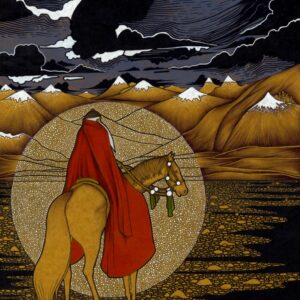 Journey to Tibet. Art print edition.
Reviews
There are no reviews yet.