Description
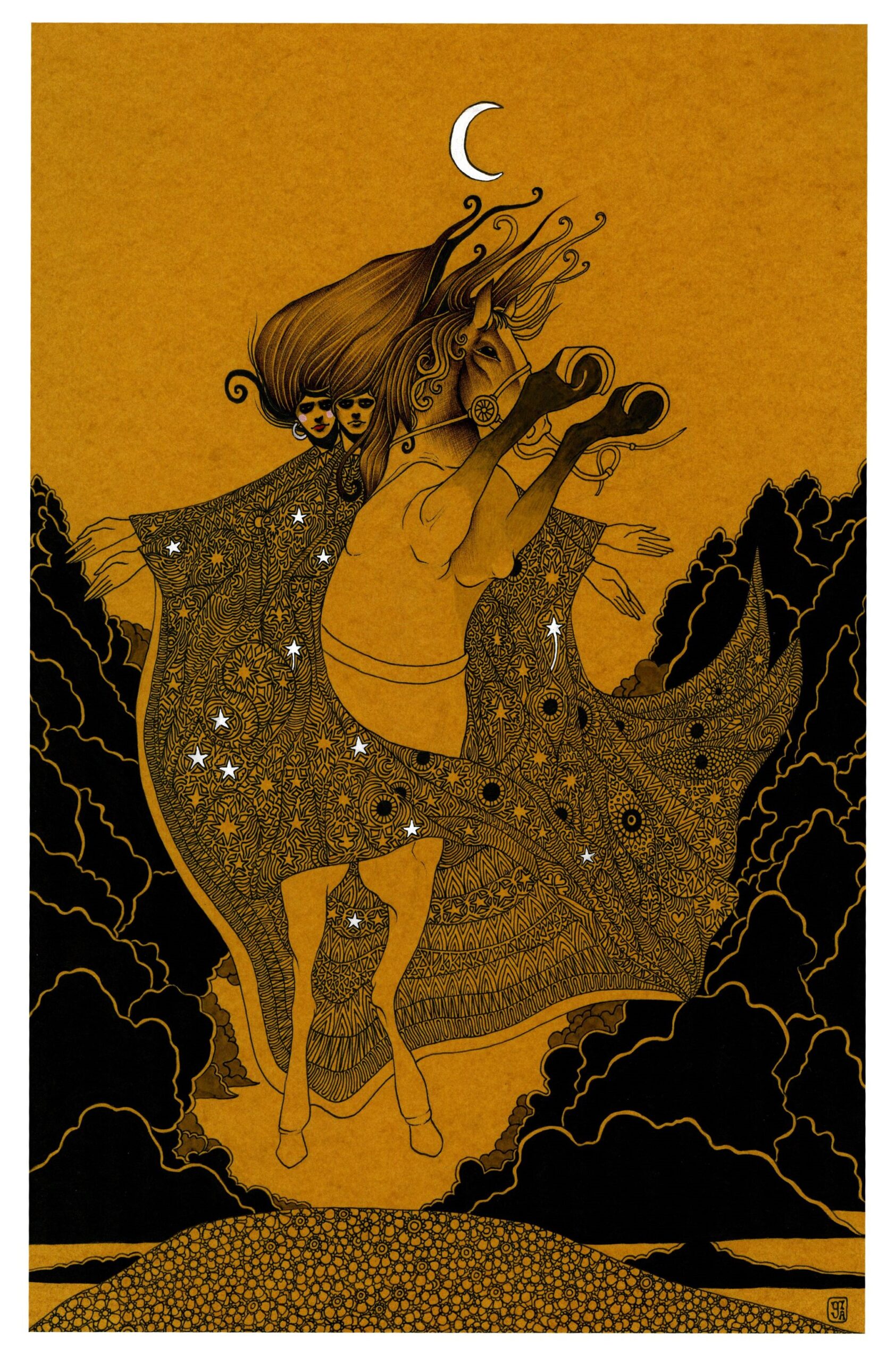
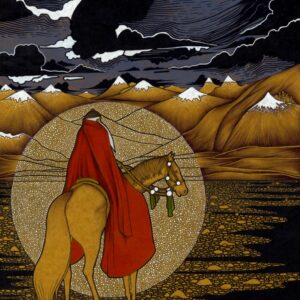
Osian and Niamh.
Print edition.
11.7 x 8.3 inches. A4
All prints are signed by the artist.
Osian and Niamh are two characters in Irish mythology, known for their love story that transcends time and space. Osian, a warrior poet, was the son of the legendary Fionn Mac Cumhaill, while Niamh was a beautiful fairy princess from the land of Tir na nOg. Their love story is often seen as a symbol of the enduring power of love and the barriers that love can overcome.
Osian and Niamh first met when Niamh came to the mortal world in search of a brave warrior to help her in her kingdom. As soon as Osian laid eyes on Niamh, he was captivated by her beauty and grace. Despite their different backgrounds and the challenges they faced, their love for each other only grew stronger with time.
One of the most famous aspects of Osian and Niamh’s story is the mythical land of Tir na nOg, where time stands still and happiness reigns eternal. The couple spent what felt like a lifetime together in Tir na nOg, surrounded by magical creatures and never having to worry about the passage of time. However, when Osian finally returned to the mortal world, he found that centuries had passed and everyone he knew was long gone.
The story of Osian and Niamh is a poignant reminder of the power of love to endure even the greatest challenges. Despite the obstacles they faced, their love for each other remained unwavering, transcending time and distance. Their story serves as a timeless reminder that love knows no boundaries and can conquer even the most impossible odds.
The tale of Oisín (Osian) and Niamh is one of Irish mythology’s most poignant love stories, rich with symbolism about the allure of the Otherworld and the tragic cost of transcending human limits.
Niamh, whose name means “brightness” or “radiance,” is a princess of Tír na nÓg (the Land of Youth). Riding a white enchanted horse, she arrives from the west—the traditional direction of the Celtic Otherworld—specifically to seek out the mortal hero Oisín, son of Fionn mac Cumhaill. She represents the eternal, divine realm: a place of perfect beauty, joy, and immortality, free from decay, death, and sorrow. Her invitation is an offer of transcendence, symbolizing the human soul’s yearning for a perfected existence beyond earthly suffering.
Oisín, the great warrior-poet of the Fianna, symbolizes humanity in its prime: heroic, creative, and deeply connected to his earthly life and kin. His decision to go with Niamh represents the soul’s choice to pursue an ideal, leaving the known world behind. In Tír na nÓg, their love flourishes for what seems three years, though centuries pass in Ireland. This time dilation is a core symbol of the Otherworld’s divine, nonlinear nature, contrasting mortal temporality with eternal bliss.
The tragedy unfolds upon Oisín’s homesick return. Niamh’s stern warning not to dismount from the white horse symbolizes the irrevocable boundary between the mortal and immortal states. When Oisín touches Irish soil, the centuries instantly claim him, aging him into a withered old man. The horse gallops back to Tír na nÓg, leaving him stranded in a changed, Christianized world where his father’s heroic age is only a memory.
Thus, the story symbolizes the irreconcilable duality of human experience: the longing for immortal perfection versus the anchoring bonds of mortal life, family, and time. Oisín’s fate is a poignant reminder that to be human is to be subject to time’s passage, and that touching the divine forever alienates one from the earthly home. It is a mythic exploration of exile, the bittersweet nature of transcendent love, and the inevitable loss that comes from crossing uncrossable thresholds.
 Journey to Tibet. Art print edition.