

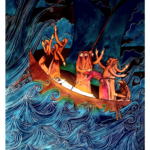

Description
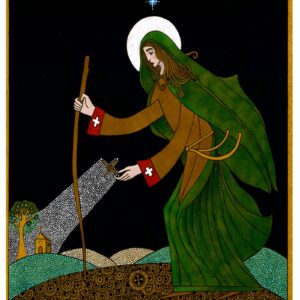
Saint Lí Ban. The mermaid Saint.
Fine art print
A4. 8.3 x 11.7 inches.
All prints are signed by the artist.
The story of Saint Liban mermaid is a fascinating tale that has been passed down through generations. Legend has it that a beautiful mermaid named Liban lived off the coast of Ireland in the sixth century. Liban was known for her wisdom and healing powers, which she used to help sailors and fishermen who found themselves in trouble at sea. She was considered a symbol of hope and protection, and many believed that she had the ability to guide lost souls back to safety.
Saint Liban’s story is a powerful reminder of the importance of compassion and selflessness in the face of adversity. Despite facing her own challenges as a mermaid living in a world that often misunderstood and feared her, she chose to use her gifts for the benefit of others. Her willingness to help those in need, regardless of their circumstances, serves as a timeless example of the impact that one individual can have on the lives of others.
In a world that can often feel dark and uncertain, the story of Saint Liban mermaid serves as a beacon of light and hope. Her legacy reminds us that no matter how difficult our own circumstances may be, there is always the possibility of turning our struggles into opportunities for growth and transformation. By embodying the qualities of kindness, generosity, and resilience that Saint Liban exemplified, we too can make a positive impact on the world around us and inspire others to do the same.
The story of Saint Lí Ban, the so-called “Irish mermaid saint,” is a profound and unique fusion of pre-Christian myth, penitential asceticism, and Christian conversion, rich with symbolism about transformation, liminality, and the redemption of the wild, untamed spirit.
Her tale begins with a divine punishment that becomes a sacred metamorphosis. As a young woman, she is miraculously preserved when her father’s palace is swallowed by Lough Neagh. For three centuries, she exists not as a human, but as a salmon-like being—a muirdris or half-fish. This initial transformation is deeply symbolic. The water represents the unconscious, the emotional and primal realm. Her fish-form signifies a state of nature-spirit, existing outside of human society and linear time, yet conscious and longing. She becomes a liminal entity, a bridge between the human world and the ancient, mysterious world of Irish water deities and sídhe. She symbolizes the soul in a state of waiting, preserved but not yet fulfilled, a keeper of ancient wisdom submerged beneath the surface of everyday life.
Her mermaid form also represents a complex penitential state. In some versions, the flood is punishment for her family’s lack of piety. Her centuries in the lake are thus a purgatorial journey, a slow purification through isolation and endurance. The fish, a Christian symbol of Christ, here takes on a paradoxical role: it is her shape of penance, yet also the vessel of her preservation, suggesting a grace even within punishment.
The core of her symbolism lies in her dual baptism. When she is finally “caught” by monks, she must choose between returning to the water or receiving Christian baptism. She chooses the latter, and upon baptism, her fish-scale skin falls away, and she receives a second, final baptism after her death. This sequence is crucial. Her first, natural life ended in a watery chaos. Her long, sub-aquatic life represents a purgatorial middle state. Her Christian baptism is a rebirth into a new, ordered cosmos—the chaos of the pagan, shape-shifting past is sloughed off for the defined salvation of the Church. She is literally converted from a nature spirit into a human soul destined for heaven.
Thus, Saint Lí Ban symbolizes the Christianization of the Irish landscape and its mythology. Her story is an allegory for the transition from the old, fluid world of pagan shapes and spirits to the new, solidified world of Christian doctrine. She is the wild, ancient soul of Ireland itself, emerging from the primal waters of its past to be baptized, named, and given a place in the heavenly communion. Her enduring appeal lies in this powerful imagery: the mermaid who chose the salvation of a saint, embodying the hope that no being, however strange or ancient, is beyond the reach of transformative grace.
https://www.youtube.com/watch?v=EUBVXCPw4A4



Reviews
There are no reviews yet.