Description
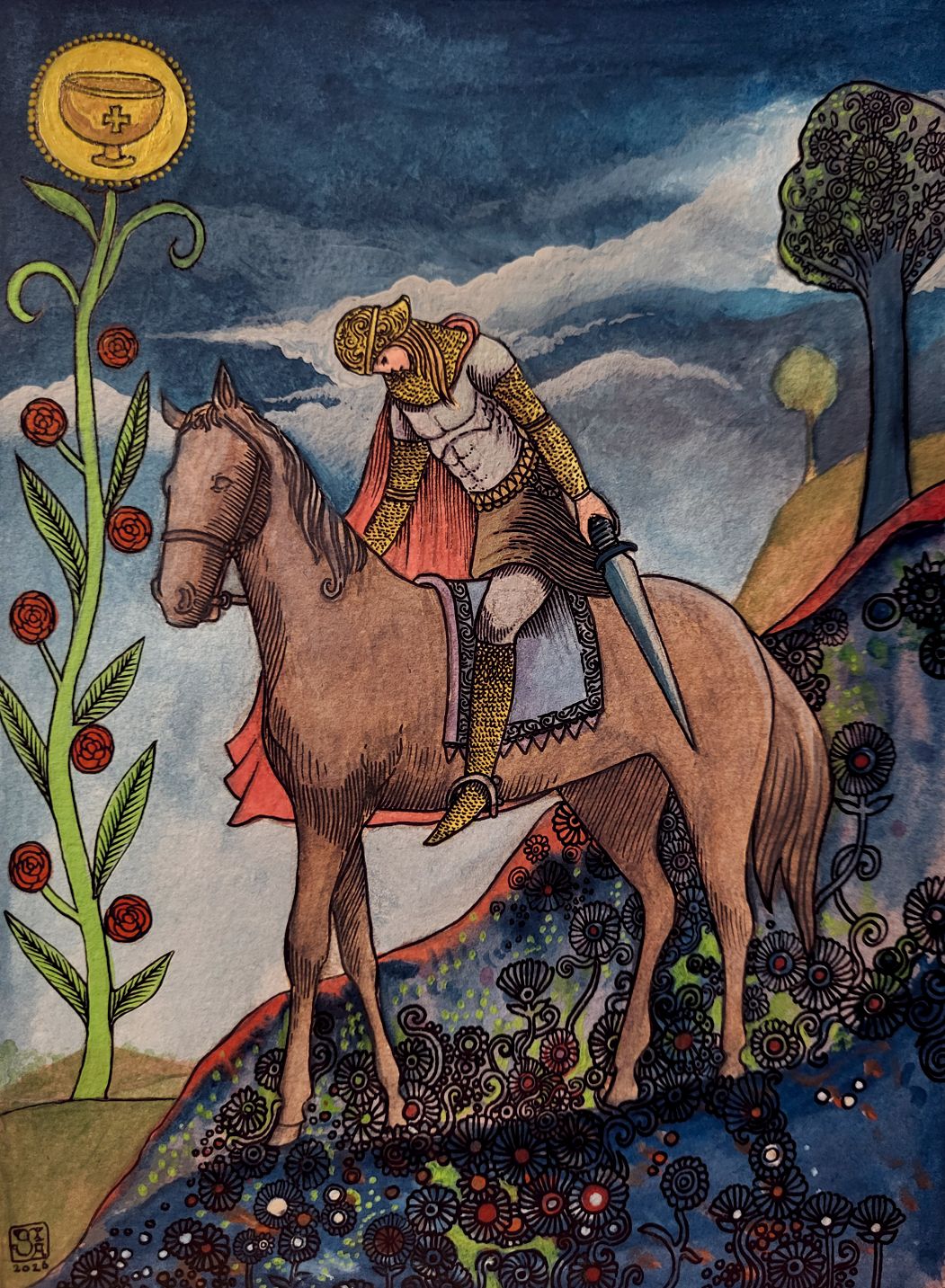
Parsifal and the Holy Grail
Mixed media on paper
5.83 x 8.27 inches
The symbolism woven throughout the story of Parsifal and the Holy Grail represents one of the most profound and multi-layered tapestries in Western art, a fusion of medieval romance, Christian theology, esoteric mysticism, and psychological exploration of the human condition. This symbolic landscape, brought to its most monumental artistic expression in Richard Wagner’s final music drama, operates on multiple levels simultaneously, each illuminating different facets of a central theme: the journey from ignorance to wisdom, from fragmentation to wholeness, and from suffering to redemption through compassion.
At the most fundamental level, the Grail itself stands as the central, enigmatic symbol whose meaning shifts depending on the source tradition. In the Christian context that heavily influenced Wagner’s conception, the Grail is explicitly identified as the sacred vessel used at the Last Supper, the cup that caught the blood of Christ as it flowed from his side wound on the cross . This establishes the Grail as a relic of supreme holiness, embodying the core mysteries of the Eucharist, sacrifice, and divine love. It represents the promise of spiritual nourishment and eternal life, yet its very presence in the kingdom of Montsalvat introduces a paradox: this source of life and grace is guarded by a community suffering from a debilitating curse. The kingdom has become a Waste Land, a desolate realm ruled by a wounded king, Amfortas, whose own physical and spiritual agony reflects the sickness of his entire domain . Thus, the Grail is not merely a passive object of veneration but an active symbol of a profound disconnection—a sacred power that, due to human failing, has become a source of torment rather than solace. It awaits a redeemer pure enough to unlock its true potential and restore its life-giving properties to the world.
Wagner’s sources, however, introduce a richer and more ambiguous layer of symbolism that complicates a purely Christian reading. Wolfram von Eschenbach, in his epic medieval poem Parzival, departs from the Christian relic tradition by describing the Grail not as a cup but as a stone called lapsit exillis, which fell from the heavens and was cared for by a company of neutral angels who took neither God’s nor Lucifer’s side during the war in heaven . This detail is symbolically crucial. The neutrality of these angels suggests that the Grail represents a transcendent principle that exists beyond the duality of good and evil, a force of cosmic unity that reconciles opposites . Wolfram’s Grail is also a stone of immense power, capable of providing limitless food and drink, granting eternal youth, and even determining who is worthy to serve it through an inscription that appears on its surface . This depiction frames the Grail as a symbol of a primordial, divine wisdom that predates and transcends institutional religion. It is a source of sustenance for the body and the soul, a principle of cosmic order that has become obscured and inaccessible to a fallen world.
The wound of King Amfortas is the symbolic counterpart to the hidden Grail, representing the visible symptom of the underlying spiritual sickness. Amfortas, the guardian of the Grail, was seduced by the enchantments of the magician Klingsor and the mysterious Kundry, and in his moment of weakness, lost the Holy Spear—the same spear that had pierced Christ’s side—which was then used to inflict a wound upon him that will not heal . This wound is the symbolic manifestation of guilt, desire, and the failure of spiritual guardianship. It is an open, festering reminder of sin that isolates Amfortas from his community and his sacred duty. Joseph Campbell, the renowned mythologist, interpreted this wound through the lens of Wolfram’s telling, where Amfortas is injured not merely by an enemy but by a pagan knight whose lance bears the word “Grail.” For Campbell, this signified that “nature intends the Grail,” suggesting that the wound was inflicted by a force of authentic, natural life that the knights of the Grail, bound by rigid spiritual law, had rejected . The injury, therefore, represents the self-inflicted severance of spirit from nature, a castration of life’s vital forces, leading to the sterility of the Waste Land. Amfortas’s unending pain, especially acute during the ceremony when he must uncover the Grail, symbolizes the agony of a soul forced to confront a sacred mystery it has proven unworthy to behold .
Opposing the kingdom of the Grail is the magician Klingsor and his realm of illusion. Klingsor, a failed aspirant to the Grail brotherhood who sought to achieve purity through self-castration, represents the perversion of the spiritual quest . Having been rejected by the knights for his impure act, he becomes their archenemy, creating a magic garden populated by seductive Flower Maidens designed to ensnare and corrupt the knights. Klingsor’s domain symbolizes the dangers of a spirituality that is violently coerced rather than organically achieved. His attempt to force purity through mutilation results not in holiness but in a deeper, more malevolent form of desire—the desire to corrupt and destroy. He embodies the shadow side of the Grail quest: the temptation to grasp at spiritual power through the will rather than through grace. His castle is a world of artifice and enchantment, a deceptive paradise that lures the seeker away from the true path with the promise of immediate, sensual gratification .
The character of Kundry is perhaps the most complex symbolic figure in the entire narrative, embodying the very principle of duality that the Grail seeks to resolve. She exists in a state of divided existence, alternating between serving the knights of the Grail and being enslaved to Klingsor’s will. In Wagner’s conception, she is linked to Herodias, a figure cursed to wander for laughing at Christ during his passion, and her existence is one of perpetual torment, seeking death and redemption across multiple incarnations . Kundry symbolizes the wild, untamed feminine principle, the force of nature that has been condemned and suppressed by a rigid spiritual order. Her laughter at the suffering of Christ represents a primal, instinctual rejection of the redemptive sacrifice, a refusal to accept the spiritual framework that would deny her own nature. Yet, she is also the agent through whom Amfortas falls and the primary temptation for Parsifal. She is simultaneously the curse and the potential vehicle for healing. In her final encounter with Parsifal, she attempts to seduce him not only with physical desire but with a profound expression of maternal love, attempting to bind him through pity . Parsifal’s ability to resist her embrace, not through cold rejection but through a new understanding of compassion, marks the turning point. Her eventual baptism and redemption at the opera’s end suggests the reintegration of the feminine and natural principle into the Grail kingdom, a healing of the primordial split that caused the Waste Land .
Parsifal himself is the embodiment of the pure fool who becomes the redeemer. His name, which Wagner derived from Persian meaning “pure fool,” encapsulates the paradoxical path to wisdom . Initially, his innocence is not wisdom but ignorance. He enters the Grail kingdom, witnesses Amfortas’s suffering, and fails to ask the crucial question: “What ails thee, Uncle?” This failure is not a moral failing but a lack of compassion born from inexperience. His journey is one of acquiring understanding through suffering and temptation. The moment of transformation comes not through heroic action but through an act of supreme empathy: when Kundry’s kiss awakens in him the consciousness of Amfortas’s pain, he feels the wound in his own soul . This moment of compassion, of suffering with another, is the key that unlocks his destiny. For Campbell, “the key to the Grail is compassion, suffering with, feeling another’s sorrow as if it were your own. The one who finds the dynamo of compassion is the one who’s found the Grail” . Parsifal’s subsequent seizing of the Holy Spear, which Klingsor hurls at him, symbolizes his mastery over the forces of division and desire. He does not use the spear as a weapon of conquest but as a tool of healing, returning it to the Grail kingdom to touch Amfortas’s wound and finally close it .
The symbolism of the Spear and the Grail, reunited at the drama’s end, represents the union of opposites and the restoration of cosmic harmony. The Spear, the masculine, active principle of divine will that caused the wound, is reunited with the Grail, the feminine, receptive principle of divine grace that contains the life-giving blood. Their separation led to suffering and sterility; their reunion brings healing and abundance. Wagner’s stage direction for the final scene underscores this symbolic union, with Parsifal holding the Spear aloft while the Grail glows with radiant light, and a white dove descends, symbolizing the Holy Spirit . This is not merely a restoration of a Christian relic but an enactment of what Jungian psychology would call the coniunctio, the sacred marriage of opposites that yields the unified self . The chorus’s final words, “Redemption to the Redeemer,” invert conventional logic, suggesting that in saving others, Parsifal has also saved himself, completing the cycle of grace.
The symbolic legacy of Parsifal and the Grail extends far beyond the opera house, permeating modern esoteric thought and even, tragically, political ideology. The identification of Wagner’s Montsalvat with the Cathar stronghold of Montségur in the Pyrenees, promoted by figures like Joséphin Péladan and later Otto Rahn, transformed the Grail into a symbol of a heretical, pre-Christian gnosis persecuted by the Roman Church . This thread was woven into a nationalist and ultimately Nazi narrative, where the Grail knights were reinterpreted as a pure, racially distinct caste whose spiritual mission was threatened by corruption. Alfred Lorenz, a Nazi musicologist, claimed that the affirmative ending of Parsifal revealed Wagner’s “prophetic thoughts” about a new religion through which “as a racially high-bred people we should advance to victory” . In this horrific appropriation, the symbols of compassion, healing, and the unity of spirit and nature were twisted into emblems of exclusion, purity, and domination, revealing how potent and dangerous such archetypal imagery can be.
Ultimately, the enduring power of the Parsifal and Grail symbolism lies in its polyvalent nature, its ability to speak simultaneously to the religious seeker, the psychological explorer, and the student of myth. At its core, it presents a model of a spiritual quest that is not about conquering external enemies but about overcoming the division within oneself. It posits that the deepest wounds—whether those of a king, a community, or a civilization—are not healed by force or by rigid adherence to law, but by an act of profound, selfless compassion. The fool who becomes the redeemer, the wound that becomes the source of healing, the wasteland that becomes a garden, and the sacred relics that promise wholeness: these are the interconnected symbols that continue to resonate, offering a vision of transformation that is as relevant to the modern individual seeking meaning as it was to the medieval audiences who first heard the tale.
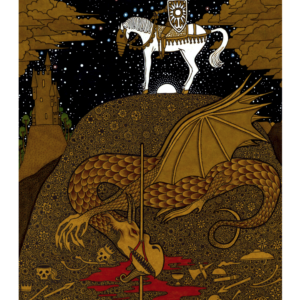 Dragon slayer. Fine art print.