Description
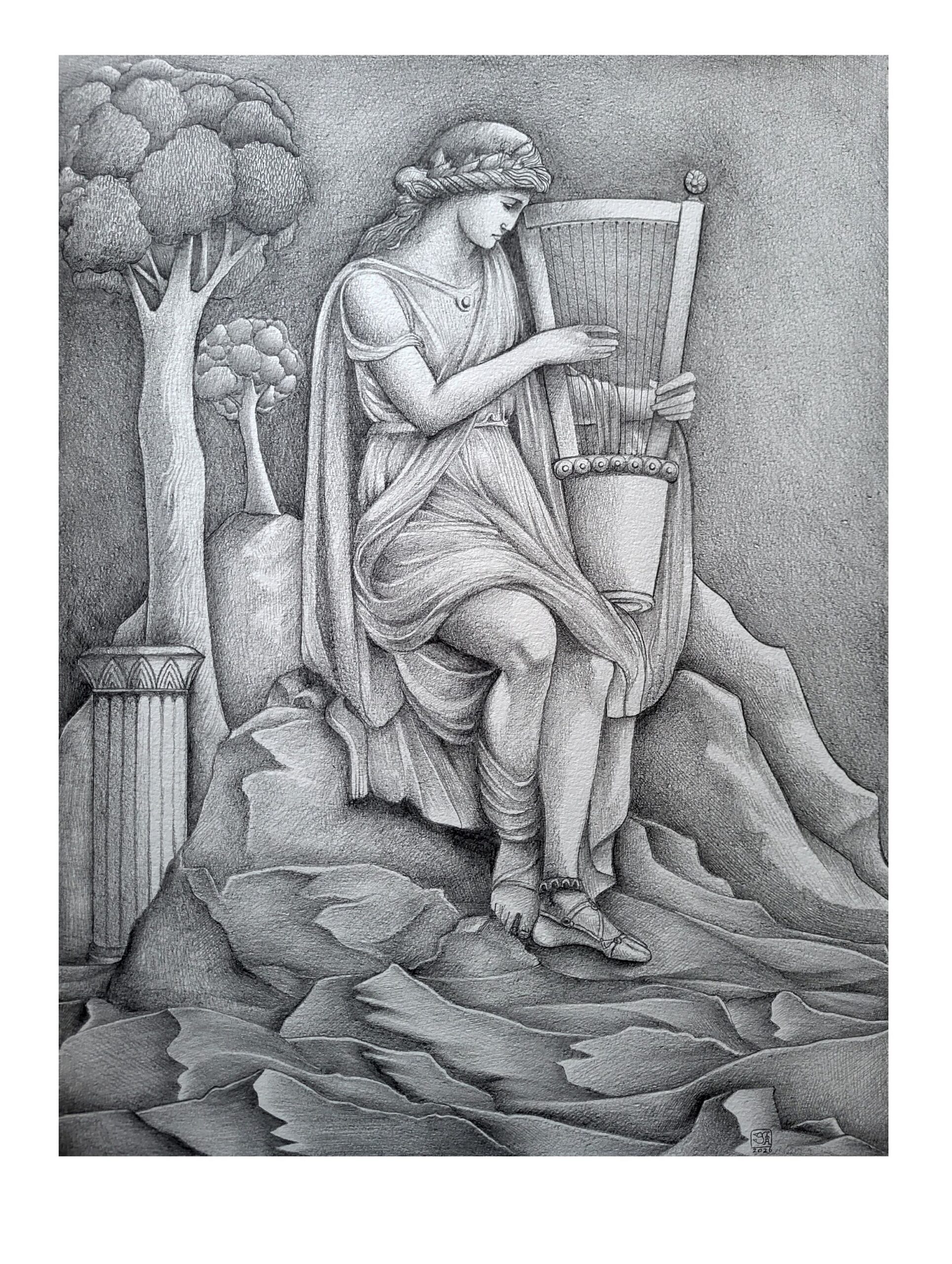
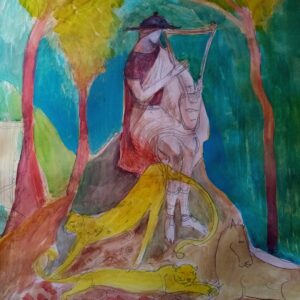
Orpheus playing the Lyre.
Original preliminary drawing for an oil painting. Graphite on paper.
16.5 x 11.7 inches
There is perhaps no image in all of Western art more resonant with the profound and paradoxical nature of human creativity than that of Orpheus playing his lyre. It is an archetype that has echoed through millennia, from the ancient Greek myths that first spawned it to the operas of Monteverdi and Gluck, the poetry of Rilke, and the films of Cocteau. The symbol is deceptively simple: a man, a musician, so skilled that his art can tame the wild beasts, move the rivers, and compel the very stones to dance. Yet, within this single frame, the entire spectrum of art’s power and its ultimate limitation is contained, a story told not in narrative, but in the vibrating strings of a lyre and the hands that command them.
At its most fundamental level, the lyre of Orpheus is the symbol of civilization itself imposing order upon chaos. In the primordial world, nature was a thing of raw, untamed, and often terrifying force. The beasts were savage, the elements were unpredictable, and the landscape was an indifferent and imposing mass. Yet, when Orpheus played, this wild world paused and listened. The lion lay down with the lamb, not out of divine commandment, but because the sheer beauty of the music re-calibrated its very essence. The trees uprooted themselves to gather closer, and the rivers slowed their relentless current to hear the melody. This is the supreme metaphor for the power of art to humanize the world, to create a space of harmony and order in the midst of natural savagery. The lyre’s music does not conquer through force, but through persuasion, through a beauty so compelling that it is irresistible. It represents the ability of human expression—through music, poetry, painting, or story—to find patterns, to create meaning, and to forge a temporary peace in the chaotic wilderness of existence. It is the sound of logos, of reason and emotion woven together into a harmonious whole that can, for a moment, still the primal chaos within and around us.
This power to charm the insensate world, however, is merely a prelude to the symbol’s deeper, more poignant meaning: art’s ability to confront and transcend the finality of death. This is the heart of the Orpheus myth, the descent into the underworld. His beloved Eurydice is taken by a serpent’s bite, and his grief finds no solace in the world above. The world he had once charmed is now empty without her. And so, he makes the ultimate journey, armed not with a sword or shield, but with his lyre. He descends into the land of the dead, a realm of shadows, silence, and absolute negation. Here, the lyre’s music becomes something more than a civilizing force; it becomes a metaphysical weapon. It confronts the ultimate silence with sound, the ultimate darkness with a shimmering light of melody. His song does not merely move stones; it moves the cold, unyielding hearts of Hades and Persephone. It causes the torments of Tantalus and Sisyphus to cease, if only for a moment. For the first and only time, the iron law of death is made to bend. The power of art, the myth suggests, is so profound that it can penetrate the deepest shadows and elicit a tear from the very gods of the underworld. The lyre, in this context, is the symbol of hope against despair, of love against oblivion, of the human spirit’s refusal to accept the finality of loss. It is the sound of grief transmuted into such pure beauty that it can, for a heartbeat, reanimate the impossible.
And yet, the true, tragic genius of the Orpheus symbol lies not in his success, but in his failure. The condition of his victory is his trust: he must lead Eurydice out of the underworld without looking back at her until they have both reached the surface. In that agonizing ascent, the silence of his lyre becomes its own kind of music. He plays no more; he only walks, filled with a hope so immense it is indistinguishable from fear. The silence is filled with the echo of his recent triumph. But doubt, that most human of afflictions, creeps in. Is she truly behind him? Has he been deceived? Is the silence of the underworld now a silence of absence? This doubt, this unbearable tension between faith and the desperate need for certainty, finally breaks him. In the quintessential act of human frailty, he looks back. In that glance, Eurydice is lost to him forever, slipping back into the shadows with only the faintest whisper of a farewell. The lyre, which had opened the gates of hell, is powerless to prevent this final, self-inflicted wound. This is the profound paradox of the symbol: art’s greatest triumph is inseparable from its ultimate limitation. It can move gods, but it cannot quiet the human heart. It can charm death itself, but it cannot overcome the doubt that is born of love. Orpheus’s art was perfect, but he, the artist, was not. His failure is not a failure of skill, but a failure of faith, a testament to the fact that the artist, the human being who wields the power of creation, is still subject to the very human emotions that inspire their art. The lyre, which brought him so close to his desire, becomes the very instrument of his eternal grief, forever associated with what was gained and then irrevocably lost.
The final, and perhaps most devastating, layer of this symbol is the fate of Orpheus after his second loss. He returns to the world, but he is a broken man. Some versions of the myth say he shunned the company of women, devoting himself only to pederastic love, an act that incited the wrath of the Maenads, the frenzied female followers of Dionysus. In their bacchic rage, they fell upon him and tore him limb from limb. Even in this grotesque and violent death, however, the lyre retains its symbolic power. As his body is dismembered and scattered, his head and his lyre float down the river Hebrus, still singing. His severed head, still uttering mournful melodies, and his lyre, still resonating with his song, drift out to sea, eventually washing up on the shores of Lesbos. The artist is destroyed, but the art remains. The body is silenced, but the song continues. This is the ultimate symbol of art’s immortality. It exists independent of its creator. The human vessel, fragile and flawed, can be broken, but the beauty it brought into the world takes on a life of its own. Orpheus, the man, dies, but Orpheus, the song, is eternal. The lyre, floating on the waves, still playing, is the perfect emblem of the legacy of art: a beauty that outlasts its maker, a voice that speaks from beyond the grave, a fragment of harmony that persists in the great, indifferent silence of the cosmos. It is the promise that while we, like Orpheus, are doomed to look back and lose what we love most, the songs we sing about that loss might just travel down the river of time forever.
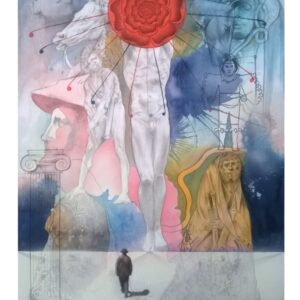 The Sacred Rose. Original art work. Mixed media on Fabriano paper.